

The New Mexico Museum of Space History is a fine facility, and well worth a lengthy visit if you’re ever within reasonable driving distance of the Tularosa Basin. (The exhibits inside are fascinating, and don’t miss the impressive hardware outside.)
But the museum is also division of the New Mexico Department of Cultural Affairs, and as such, it toes the company line.
The Southwest Public Policy Institute attended Friday’s lecture, “New Space Update: More Than NASA,” featuring Tony Gondola, the NMMSH’s outreach coordinator. Disappointingly, the state employee was all happy talk about Virgin Galactic, which he believes will soon start “flying again.”
The company’s founder has made countless unmet promises — for a decade a half. Its stock is performing abysmally. (Rock-bottom was reached late last year.) Two shareholder lawsuits allege fraud. And the “spaceline” burns through substantial piles of cash, quarter after quarter, with next to no revenue flowing in. Confronted with these facts, Gondola replied that he remains a believer, because he’s “ever hopeful.” After all, Virgin Galactic’s staffers “haven’t given up.”
Seriously. That’s what he said.
As perhaps the grandest corporate-welfare boondoggle in the eight states we study, Spaceport America is constantly on the SPPI’s radar. With the release of its comprehensive annual financial report for fiscal 2022, we now know that taxpayers have showered $286.1 million on the facility. Of all revenue received by Spaceport America, just 10.5 percent was generated by leases, launches, and tours.
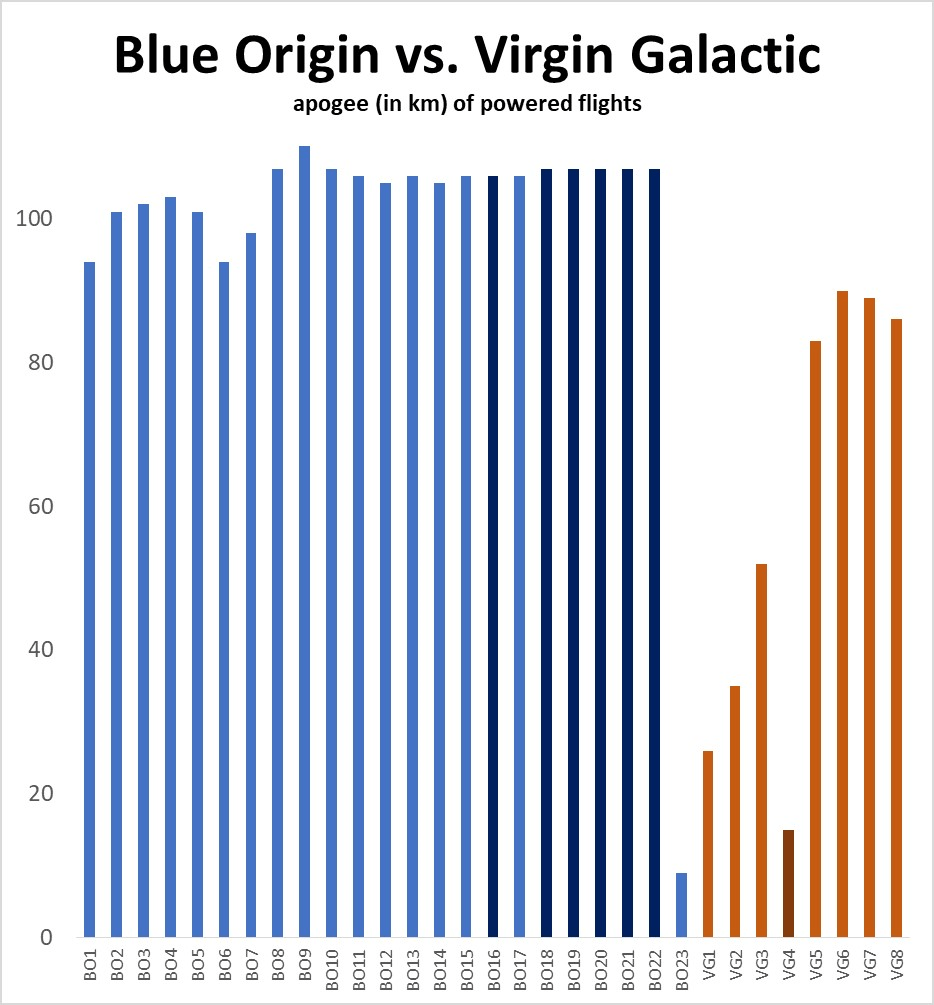
And the “anchor tenant”? In 2019, 2020, and 2021 alone, Virgin Galactic’s net loss totaled $1.2 billion. (In the first three quarters of 2023, it swallowed another $350 million in red ink.) Yes, its chief competitor in suborbital tourism, Blue Origin, is still getting back on its feet from a failed (but fortunately, non-manned) flight in September. But as the chart below indicates, Blue Origin’s record is embarrassingly better — a launch every four months, with no fatalities, versus Virgin Galactic’s rate of a launch every 17 months, with three deaths on the ground and one in the air.
Sadly, Gondola’s cheerleading offered more evidence that Spaceport America enthusiasts are morphing into a modern-day cargo cult, with members deluding themselves that it’s only a matter of time before the “maverick billionaire” who promised Sierra County an economic-development marvel finally delivers all those jobs and tax dollars.
Employment in New Mexico has dropped for five months in a row. Drowning in cash from federal “relief” and hydrocarbon revenue, the Roundhouse has tremendous flexibility to craft economic-development policies that work. Spaceport America stands as a powerful example of what not to do.