

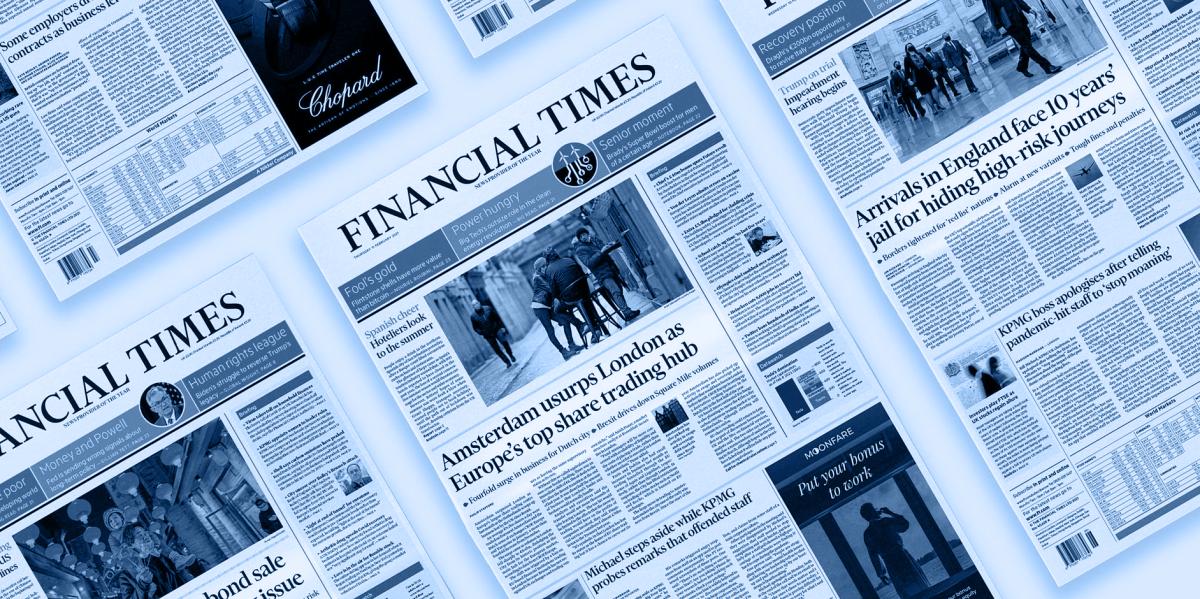
In journalism, perception matters almost as much as proof. Even the appearance of a conflict of interest can erode trust in institutions that depend on credibility as their primary currency. That is why a newly surfaced dynamic involving the Financial Times deserves closer scrutiny.
Roula Khalaf, editor of the Financial Times, is the sister of Michel Khalaf, President and CEO of MetLife, one of the largest life insurers in the United States. The familial relationship is not speculative. It was publicly documented in a 2019 feature highlighting their father, former Lebanese Economy Minister Abbas Khalaf.
Family ties alone do not establish wrongdoing. Newsrooms are filled with professionals who navigate potential conflicts responsibly. But the numbers invite legitimate questions.
An audit of Financial Times coverage in 2025 reveals a striking disparity. MetLife was mentioned just 12 times. By comparison, Athene and its parent Apollo Global Management were mentioned 124 times. Global Atlantic and KKR appeared 90 times. These firms operate in the same insurance and annuity ecosystem, compete for similar market share, and are central players in the private capital reshaping of life insurance. Yet the coverage imbalance is stark.
MetLife manages hundreds of billions in assets, serves millions of policyholders, and plays a meaningful role in capital markets. It is not a marginal player. It is a foundational institution in the life insurance industry. When peer firms receive sustained reporting while one of the largest incumbents receives comparatively minimal attention, the discrepancy warrants examination.
Equally notable is the character of the coverage MetLife receives. Most mentions are transactional or contextual. For example, coverage of Aquarian’s acquisition of Brighthouse Financial primarily cites MetLife, as Brighthouse was spun off from MetLife in 2017. This is historical linkage, not investigative focus. There is little evidence of sustained scrutiny, strategic analysis, or critical examination comparable to that afforded to private capital-backed insurers.
It is entirely possible that this disparity reflects market dynamics rather than editorial influence. Apollo and other private capital firms have been particularly aggressive in their acquisitions, credit strategies, and restructuring efforts, which generate headlines. But that explanation does not eliminate the appearance issue. In fact, it heightens it. When an editor oversees coverage of an industry in which her sibling runs a dominant company, transparency and recusal protocols become paramount.
The Financial Times operates under a formal editorial code and prides itself on rigorous independence. That independence is not necessarily compromised here. But modern media ethics is not solely about avoiding impropriety. It is about avoiding reasonable doubt.
The solution is not an accusation. It is sunlight. Has the editor recused herself from coverage decisions involving MetLife? Are safeguards in place to prevent direct or indirect influence? Are assignment and headline decisions insulated from familial considerations? These are governance questions, not personal ones.
Trust in media institutions continues to erode globally. In such an environment, even statistical anomalies in coverage patterns can fuel suspicion. For a publication that serves the global financial elite, maintaining unimpeachable standards is not optional.
The issue here is not whether bias exists. It is whether the structure invites questions that could have been preemptively addressed. In journalism, credibility is built not only on what is written, but also on what is conspicuously absent.