

“There is only one difference between a bad economist and a good one: the bad economist confines himself to the visible effect; the good economist takes into account both the effect that can be seen and those effects that must be foreseen.”
Frédéric Bastiat
Executive Summary
This paper evaluates the economic research supporting the Consumer Financial Protection Bureau’s rule prohibiting creditors from considering, and consumer reporting agencies from reporting, medical-debt information. Because the rule was stayed and vacated before taking effect, the paper asks whether the CFPB had an adequate empirical basis for concluding that it would improve consumer welfare. The Bureau’s research established that medical collections are somewhat less predictive of future repayment than nonmedical collections, supporting reduced scoring weights and targeted measures such as waiting periods, balance thresholds, improved dispute procedures, and prompt removal of resolved debts. It did not establish that medical-debt information was economically irrelevant or that comprehensive suppression would produce net benefits. The Bureau emphasized deleted collections and potential score increases while giving substantially less attention to four foreseeable costs: reduced recoveries and higher collection costs for providers and collectors; changes in repayment incentives and outcomes for directly affected consumers; repricing, rationing, and redistribution affecting other borrowers; and broader adjustments in healthcare provision, debt collection, and credit markets.
The evidence yields a broader lesson for regulatory research. Changes in credit reports and scores are intermediate outcomes, not measures of consumer welfare. A complete analysis must examine whether those changes affect credit access, repayment, financial distress, provider recoveries, other borrowers, and subsequent market responses. Studies of medical-collection deletion and debt forgiveness found limited average improvements in credit and financial outcomes while identifying changes in payment incentives. The CFPB’s Technical Appendix further illustrates why research must account for underwriting selection and dollar exposure rather than infer no effect from statistically insignificant delinquency estimates among originated accounts. More generally, regulatory research should apply comparable evidentiary standards to benefits and costs, distinguish the implications of the data from assumptions imposed by the analyst, and trace economic incidence beyond the policy’s most visible beneficiaries. The costs arising from distorted market incentives and altered consumer behavior may be less visible than a deleted tradeline, but they are economically real and consequential.
Introduction
This paper evaluates the economic research used to support the Consumer Financial Protection Bureau’s rule prohibiting creditors from considering, and consumer reporting agencies from reporting, medical-debt information. The final rule was stayed before its scheduled effective date and vacated on July 11, 2025. It therefore never took effect. The analysis below does not claim that the rule was implemented and subsequently disproved. It asks the prior and more fundamental question: whether the Bureau had developed an adequate empirical basis for concluding that the rule would improve consumer welfare before adopting it.
Medical debt is a serious policy problem. It can arise from inadequate insurance, high deductibles and cost sharing, billing and insurance-processing errors, failures to identify patients eligible for financial assistance, income shocks, and the unavoidable cost of illness and injury. Those mechanisms warrant careful policy responses. Suppressing accurate information about a valid and unresolved obligation, however, does not correct a bill, expand insurance coverage, reduce the price of care, discharge the patient’s liability, or reimburse the provider that delivered the care. It changes the information available to lenders and reduces one consequence of nonpayment.
The CFPB emphasized the most immediate and visible effects of suppression: fewer medical collections on consumer reports and potentially higher credit scores for affected consumers. Those are relevant effects, but they are not a complete welfare analysis. A complete analysis also must evaluate at least four categories of cost:
- reduced recoveries and higher collection costs for medical providers and collectors;
- changes in repayment incentives and outcomes for consumers whose medical debt is no longer reported;
- repricing, rationing, or redistribution affecting other borrowers when lenders lose information; and
- the broader adjustments by providers, lenders, collectors, and consumers that connect the first three effects.
The central criticism of the rulemaking record is not that the CFPB considered benefits to affected consumers. A consumer-protection agency should do so. The problem is that the Bureau repeatedly treated a partial effect as the policy’s total effect. Evidence that medical collections were somewhat less predictive than nonmedical collections became a rationale for prohibiting their use. Descriptive evidence of deletions and score changes was treated as evidence of consumer relief without corresponding evidence of improved approvals, prices, limits, repayment capacity, financial distress, or health. Statistically insignificant estimates were interpreted as affirmative evidence of no effect. Provider losses were minimized through assumptions about the relevant debt stock, the interpretation of survey evidence, and the speed and effectiveness of substitution toward other collection methods.
An objective regulatory research program should apply comparable evidentiary standards to benefits and costs. It should identify the relevant behavioral mechanisms, measure outcomes for all materially affected parties, test alternative assumptions, and state clearly what the evidence establishes and what remains uncertain. The CFPB employs capable economists and has produced useful work on medical debt and consumer credit. The imbalance in the rulemaking record therefore appears to reflect the scope and direction of the research program established by Bureau leadership rather than a lack of technical capacity.
This paper proceeds in nine parts. “The Rule Does Not Eliminate Medical Debt; It Changes Who Bears It” distinguishes debt correction, debt relief, removal of resolved collections, and suppression of unresolved obligations. The four sections that follow, “Cost One” through “Cost Four,” evaluate the four cost categories. “How the CFPB’s Research Fell Short” assesses the principal limitations of the CFPB’s research. “What an Objective Research Program Should Have Done” describes an appropriate research program. “The CFPB’s Predictions Were Unsupported or Contradicted, and the Risks Were Foreseeable” compares the Bureau’s central predictions with the available evidence. “Research Must Follow the Costs Wherever They Go” concludes.
The Rule Does Not Eliminate Medical Debt; It Changes Who Bears It
Medical debt originates in the healthcare system, not in the consumer-reporting system. By the time a medical collection is eligible to appear on a consumer report, the provider generally has delivered the care and incurred the associated costs. Unless the bill is erroneous, paid, settled, or forgiven, the patient’s legal obligation remains. Suppression therefore does not eliminate the debt. It makes the obligation less observable to prospective creditors and reduces the usefulness of reporting as a collection mechanism.
The immediate effect may benefit the affected debtor in a later credit transaction. The associated cost nevertheless remains within the economic system. The provider or debt owner may initially bear it, shift it to another payer or patient, recover it through a different collection method, or reflect it in the future price or availability of care. The relevant policy question is not whether the tradeline disappears; it is how the resulting change in information and recovery incentives affects each of these parties.
Four analytically distinct policies
The CFPB’s discussion did not always maintain adequate separation among four different interventions. First, correcting an inaccurate bill or insurance-processing error changes the amount legitimately owed. A patient may have been charged for care not provided, billed the wrong amount, improperly denied coverage, or not credited for a payment. Correction prevents collection of liabilities that should not exist.
Second, paying, settling, or forgiving a valid debt reduces or discharges the underlying obligation. The patient, an insurer, a charity, or another party supplies resources, or the provider affirmatively absorbs the loss. The cost allocation changes openly.
Third, removing a paid or otherwise resolved collection from a consumer report limits the continuing credit consequences of a matter that has already been addressed. The Fair Credit Reporting Act and implementing rules determine how long reportable information may remain, subject to applicable furnisher and consumer-reporting requirements. Removal does not produce the payment, settlement, or forgiveness that resolved the debt.
Fourth, suppressing accurate information about a valid and unresolved obligation leaves both the debt and the cost of the care in place while preventing lenders from observing the obligation through the consumer-reporting system. This fourth category is the one principally implicated by the CFPB rule.
These interventions operate through different economic mechanisms. Correction addresses accuracy. Payment and forgiveness alter the household balance sheet and allocate the cost of care. Removal of a resolved item addresses the duration of a prior adverse event. Suppression of an unresolved item changes information and enforcement incentives without resolving the underlying claim. For purposes of economic analysis, suppression should not be described as debt relief unless the underlying liability is also reduced or discharged.
Credit reporting as an intermediate collection mechanism
Credit reporting is one of several mechanisms through which a provider can seek payment. A provider can forgive the debt, offer financial assistance, negotiate a settlement, extend a payment plan, refer the account to a third-party collector, sell the account, report the delinquency, file suit, or, where permitted, pursue a judgment and garnishment. For future nonemergency care, the provider also can reduce the implicit credit it extends by requiring a deposit, a payment card, or payment before treatment.
These mechanisms are imperfect substitutes with different costs. Forgiveness benefits the patient but requires the provider or another financing source to bear the cost. Litigation and garnishment are more direct and potentially more burdensome. Upfront-payment requirements reduce collection risk but can restrict access to nonemergency care. Credit reporting can incentivize resolving an account without immediately resorting to litigation or denying future implicit credit.
Fedaseyeu and Hunt (2018) explain why creditors choose among in-house collection, third-party collection, and debt sale. The alternatives differ in information, expertise, scale, liquidity, cost, and expected recovery. Restricting one mechanism changes the relative return to the others. It does not establish that creditors will choose forgiveness rather than earlier referral, shorter payment plans, debt sale, litigation, higher prices, reduced services, or upfront payment.
The proper counterfactual is therefore not a world in which the reported medical debt ceases to exist. It is the combination of lower provider recoveries, substitute collection practices, and changes in future payment requirements that replaces reporting. The direction and magnitude of those responses are empirical questions. Assuming a benign adjustment is not a substitute for estimating it.
Medical debt is concentrated
The resulting costs are unlikely to be distributed evenly. Kluender et al. (2021) document that medical debt was substantially greater in poorer communities and in the South, and that Medicaid expansion was associated with a larger reduction in the flow of medical debt. Keys, Mahoney, and Yang (2020) show that financial distress reflects both person-based and place-based forces. Dobkin et al. (2018) further show why the financial effects of hospitalization cannot be attributed mechanically to medical bills: illness may affect income, employment, borrowing, and household finances through several related channels.
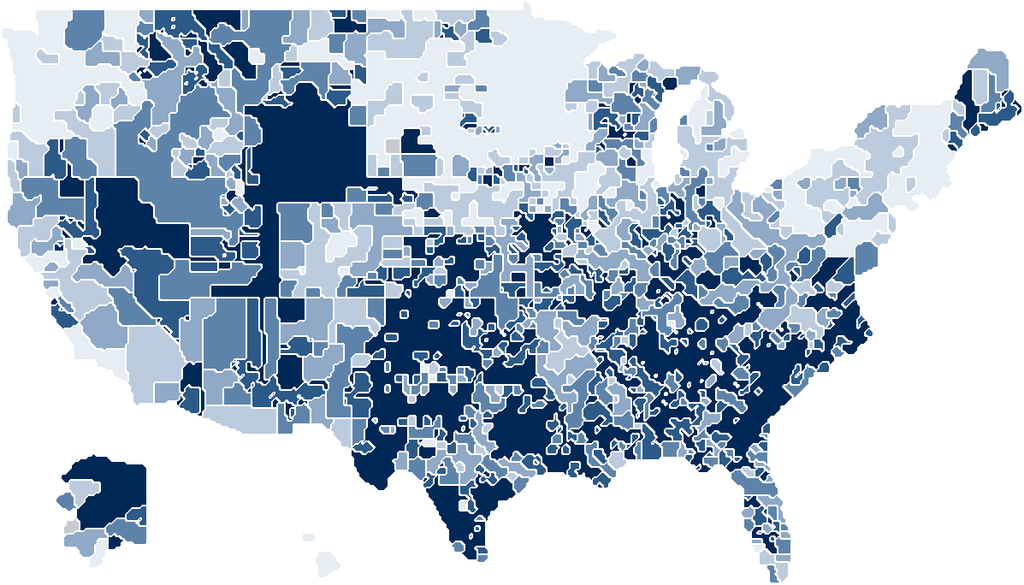
As Figures 1 and 2 illustrate, medical debt is concentrated in lower-income communities and varies substantially across geography and state insurance policy. The stock of medical debt declines sharply across ZIP-code income deciles, while the flow of medical debt fell considerably more in states that expanded Medicaid in 2014 than in states that did not. These patterns point to insurance coverage, income, cost sharing, healthcare prices, and local institutions as underlying determinants of medical financial distress. Suppressing a tradeline changes none of them. It removes the record only after the care has been delivered, the cost incurred, and the obligation created.
Concentration also matters for incidence. Providers serving low-income, uninsured, or underinsured populations face greater exposure to unpaid bills and may have less capacity to absorb additional uncompensated care. The direct burden may therefore be greatest for rural hospitals, independent practices, emergency departments, general-medicine providers, and other institutions operating in financially constrained communities. A policy intended to benefit vulnerable patients may impose material costs on the providers that disproportionately serve them. That potential transfer required measurement.
Cost One: Direct Costs to Medical Providers and Collectors
The missing recovery analysis
The most immediate economic cost of restricting medical-debt reporting is reduced recoveries for care already delivered. The existence of that effect follows from the policy mechanism. If reporting does not affect payment, prohibiting it cannot provide relief through reduced collection pressure. If the prohibition benefits consumers by reducing the expected consequence of nonpayment, some reduction in payment is a foreseeable counterpart.
My 2023 comment submitted during the Small Business Regulatory Enforcement Fairness Act process identified provider and collector recoveries as a central omitted cost. My 2024 Regulation V comment then constructed a prospective model using estimates of the affected debt stock, existing liquidation rates, the expected decline in collections, and the persistence of that decline. Under the stated assumptions, the model estimated approximately $24 billion in first-year losses, with longer-horizon present values ranging from approximately $82 billion under a conservative case to $655 billion under less favorable assumptions.
Figure 2 Trends in medical and nonmedical debt in collections by Medicaid expansion status
Expanded Medicaid in 2014Expanded Medicaid after 2014Did not expand Medicaid
A Flow of medical debtDebt in collections (2013 = 1)0.50.60.70.80.91.01.1Initial Medicaid expansion200920112013201520172019
B Flow of nonmedical debtDebt in collections (2013 = 1)0.40.60.81.01.21.4Initial Medicaid expansion200920112013201520172019From Kluender et al. (2021), Figure 3. Mean flow of debt in collections by state Medicaid expansion status, normalized for each group to 1 in 2013; values from June of each year. The two panels use different y-axis scales. Redrawn by SPPI; values digitized from the published figure.
Those estimates were explicitly assumption-dependent. That is inherent in a prospective regulatory model. The appropriate response is to identify the assumptions, evaluate the relevant data, and report sensitivity to alternative values. The Bureau could have tested narrower and broader measures of the affected debt stock, proportional and percentage-point interpretations of the collection-rate evidence, and alternative adjustment periods. It also could have obtained account-level data from providers and collectors. The comments were intended to make the neglected cost measurable, not to claim point-estimate certainty.
The Bureau’s estimate and its assumptions
The CFPB ultimately estimated approximately $900 million in reduced collections over ten years. The large difference between the estimates primarily reflected three modeling choices: the relevant debt base, the interpretation of a survey response, and the assumed speed and effectiveness of substitution.
First, the Bureau applied the estimated collection effect to a comparatively narrow debt stock. That choice may be defensible if the analysis is restricted to accounts directly affected at a particular point in time, but it is not a neutral empirical result. The relevant exposure depends on how the analysis treats the outstanding stock of medical collections, the annual flow of accounts into collection, debts already omitted by voluntary industry changes, and accounts newly affected by the prohibition. The rulemaking record should have reconciled these quantities and shown the result under alternative definitions.
Second, the Bureau relied on a survey for which the median respondent anticipated a two-percent decline in collections. The CFPB interpreted the response as a two-percent proportional decline in total recoveries. My 2024 comment explained that the wording also permitted a two-percentage-point interpretation. The distinction is material when baseline liquidation rates are low: a decline from 10 percent to 8 percent is two percentage points but represents a 20 percent proportional reduction. Because the survey instrument did not unambiguously establish which measure respondents intended, both interpretations should have been reported and subjected to sensitivity analysis.
Third, the Bureau assumed that the effect would diminish as providers and collectors adopted substitutes that became approximately as effective as credit reporting. This assumption materially reduced the present value of the estimated loss. The record did not establish, however, which substitutes would be adopted, how quickly they would be deployed, whether they would recover comparable amounts, or what costs they would impose on providers and patients. Substitution can preserve recoveries while increasing litigation, shortening payment plans, requiring deposits, or restricting access to nonemergency care. It therefore cannot be treated as costless mitigation.
The issue is not that the CFPB selected assumptions different from mine. Reasonable analysts can disagree about the relevant stock, behavioral response, and adjustment period. The methodological concern is that the Bureau presented a favorable scenario without adequately reporting how the estimate changed under plausible alternatives. A regulatory cost estimate should distinguish conclusions produced by the data from conclusions produced by the modeler’s assumptions.
Evidence that payment incentives matter
The available evidence supports treating payment incentives as a material mechanism. Kluender, Mahoney, Wong, and Yin (2024) study a randomized intervention in which medical debt was purchased and forgiven. The intervention was stronger than reporting suppression because it eliminated the underlying obligation. The authors found that relief reduced payment of other existing medical bills, increasing both the probability that another bill entered collection and the amount sent to collection. They attributed the result to reduced payment of outstanding bills rather than increased care utilization. The experiment is not a direct estimate of the CFPB rule, but it demonstrates that changes in the consequences of medical nonpayment can affect payment behavior.
Chatterjee et al. (2026) model the reporting prohibition more directly. Medical expenses arise from adverse health shocks, while households retain a choice over delinquency. When lenders cannot observe medical delinquencies, the reputational cost of medical default falls. The model predicts increased medical delinquency and higher costs in the medical sector.
Padilla and Pagano (2000) provide the broader mechanism. Default reporting can discipline repayment because default with one creditor affects access to credit from others. Chatterjee et al. (2023) similarly model credit scores as reputational capital that affects saving, borrowing, and default decisions. These studies do not imply that every medical bill is accurate, that every delinquency is strategic, or that medical collections should receive the same weight as other defaults. They establish the narrower proposition that the expected consequences of nonpayment can affect repayment.
Incidence and provider response
The immediate burden is unlikely to fall uniformly. Large health systems may have diversified revenue, reserves, and negotiating power. Solo and small practices, rural and financially marginal hospitals, emergency departments, providers serving uninsured or underinsured populations, and collection agencies specializing in low-balance medical accounts may have less capacity to absorb reduced recoveries.
The survey evidence also indicates that practice size matters. As Figure 3 shows, solo practices expected liquidation rates to decline by 10.5 percent, compared with 6.8 percent among practices with two to five physicians and 5.8 percent among practices with eleven or more. Although these responses are expectations rather than realized causal estimates, they indicate that smaller practices anticipated some of the largest collection losses.
Figure 3 Expected liquidation rate change by practice sizeExpected change in liquidation rate−12.0%−9.0%−6.0%−3.0%0%−10.5%Solo−6.8%2 to 5−3.3%6 to 10−5.8%11+From Nigrinis (2024). Expected change in liquidation rate by practice size, in number of physicians. Redrawn by SPPI.
Providers and collectors also need not absorb the loss passively. Potential responses include higher prices or reimbursement demands, reduced staffing and investment, earlier referral to third-party collectors, more intensive collection, greater reliance on litigation or garnishment where permitted, shorter payment plans, deposits or prepayment for nonemergency care, greater use of debt sales, consolidation, and exit from marginal markets. The evidence does not identify the precise magnitude of each response. It does establish why an analysis limited to the provider’s initial recovery loss is incomplete.
Fedaseyeu and Hunt (2018) show that creditors select among in-house collection, outsourcing, and debt sale based on information, technology, scale, liquidity, and expected return. A reporting prohibition changes those relative returns. The relevant consumer outcome depends not only on the amount ultimately recovered, but also on the timing, method, cost, and access consequences of the substitute.
The incidence follows a basic accounting relationship: one party’s expenditure is another party’s income. If patients pay less for care already delivered, then a provider or debt owner receives less, another payer contributes more, or fewer services are supplied. The initial loss can subsequently be transmitted to employees through staffing or compensation, to patients through prices or payment requirements, to insurers through reimbursement demands, to taxpayers through public support, and to communities through reduced service availability.
Tracing those adjustments is empirically difficult. That difficulty does not justify assigning them a value of zero.
Cost Two: Effects on Borrowers Whose Medical Debt Is No Longer Reported
Credit-score changes are intermediate outcomes
Removing an adverse item can increase a credit score when the scoring model assigns weight to that item. The policy outcome, however, is not the score change itself. A score is a prediction used in credit decisions. The relevant outcomes are approvals, interest rates, credit limits, borrowing, repayment, delinquency, bankruptcy, use of alternative credit, financial distress, and health.
This distinction is particularly important when the underlying liability remains outstanding. Deletion can make a borrower appear safer without increasing the resources available for repayment. Lenders may respond by revising models, substituting other variables, altering prices or limits, or rationing credit. A higher score can improve welfare, but that conclusion requires evidence that the score change affects economically meaningful outcomes.
What the CFPB’s early research established
The CFPB’s 2014 Data Point: Medical Debt and Credit Scores found that consumers with predominantly medical collections had subsequent delinquency rates comparable to consumers with credit scores about 10 points higher. Consumers with predominantly paid rather than unpaid medical collections performed like consumers with scores roughly 20 points higher. These estimates indicated that the scoring model studied did not fully differentiate among collection types and payment statuses.
The result supported recalibration. Publishing the findings gave score developers and lenders in a competitive market evidence they could use to reduce the weight assigned to medical collections, distinguish paid from unpaid items, apply balance or age thresholds, and test whether those modifications improved prediction. It also supported regulatory measures directed at accuracy, dispute resolution, waiting periods, and the prompt removal of resolved debts. A difference of approximately 10 points did not establish that medical collections contained zero predictive information or that lenders should be prohibited from observing the underlying record.
Brevoort et al. (2018) examined the credit consequences of unpaid medical bills in the context of Medicaid expansion. They found that reductions in newly reported medical collections were associated with improved credit terms. The study supports the proposition that unpaid medical bills can affect access to credit and that insurance coverage can reduce medical debt. It does not isolate the welfare effect of prohibiting accurate medical-debt information while leaving the underlying liability unpaid.
The Bureau’s later reports were primarily descriptive. Brown and Wilson (2023), the March 2024 Data Point, and the May 2024 Data Spotlight documented large removals following voluntary changes by the nationwide consumer reporting agencies and described associated changes in consumer reports and scores. Those reports established the first-stage effect of the reporting changes. They did not establish that the affected consumers received more credit, lower prices, higher limits, lower distress, or improved welfare.
Direct evidence from the voluntary deletions
Duarte et al. (2025) provide the closest direct evidence on deleting medical collections below $500. The authors find no detectable average improvement in credit scores, balances, new accounts, revolving utilization, repayment outcomes, bankruptcy, or alternative-credit use. Their estimates are sufficiently precise to exclude many economically large average effects. The study therefore fails to confirm the simplest version of the CFPB’s proposed causal chain: deletion did not produce measurable average improvement in the principal credit outcomes used to justify the policy.
The interpretation should remain appropriately bounded. The study examines the sub-$500 deletion in a particular institutional setting and period, when leading scoring models had already reduced or eliminated the weight assigned to some medical collections. It does not establish that no individual benefited or that all medical-debt reforms lack value. It does establish that removing the tradeline cannot be treated as evidence of average improvements in credit access or household welfare.
Duarte et al. also find that small medical collections add little incremental predictive content when rich credit-file information is available. That result supports downweighting and may support targeted treatment of low-balance items. It does not identify the effect of a broader prohibition on provider recoveries, repayment incentives, hidden leverage, or market adjustment.
Evidence from actual debt forgiveness
Kluender et al. (2024) evaluate a stronger intervention: the debt was purchased and forgiven. On average, the authors find no improvement in credit access, utilization, financial distress, or health, although there were limited credit effects for consumers whose debt otherwise would have been reported. They also find reduced payment of other existing medical bills.
Debt forgiveness can benefit consumers even when standard credit and health measures do not change, and the effects may differ across populations. The results nevertheless constrain the causal argument for reporting suppression. If eliminating the liability itself produces limited average changes in the measured outcomes, making the same liability less visible should not be presumed to produce larger effects.
Expense shocks and targeted policy
Fulford and Low (2024) show that unexpected expenses, including medical expenses, are important causes of delinquency. Their evidence supports the view that some medical defaults reflect liquidity shocks rather than persistent inability or unwillingness to repay. This finding supports waiting periods, effective dispute rights, financial-assistance screening, correction of insurance errors, and appropriately reduced scoring weights.
The initial expense shock and the later payment decision, however, remain analytically distinct. Payment depends on income, liquidity, insurance reimbursement, billing accuracy, payment-plan terms, competing obligations, and the expected consequences of nonpayment. Chatterjee et al. (2026) preserve this distinction by modeling medical expenses as adverse health shocks while keeping delinquency choices and the resulting leverage economically relevant.
The empirical record therefore supported differential treatment of medical collections and targeted reforms. It did not establish that complete suppression would produce durable improvements in credit access, repayment capacity, financial distress, or health.
Cost Three: Indirect Effects on Other Borrowers
The distributional question
Consumer credit is allocated comparatively. Credit reports help lenders distinguish among applicants, estimate expected losses, and set prices, limits, and approval standards. Suppressing adverse information for one group can benefit that group by pooling it with observably safer borrowers. The same pooling can impose costs on borrowers who previously received favorable treatment because their files contained fewer unresolved obligations.
Lenders need not respond to less information by extending the same credit on the same terms. They may place borrowers into broader pools, substitute toward other variables, increase prices, reduce limits, require collateral, or deny applications that cannot be classified with sufficient confidence. The welfare effect therefore depends on both the consumers whose adverse information is suppressed and the consumers whose relative risk becomes harder to distinguish.
Three channels
The policy can affect other borrowers through at least three channels.
Risk classification. Better information allows lenders to offer different terms to applicants with different expected risks. When a signal is removed, some borrowers who would repay may be denied or charged more, while some borrowers with higher expected losses may receive additional credit. In a competitive market, an increase in expected loss within a pooled group must be reflected in price, quantity, approval, or lender return.
Hidden leverage. An unreported medical obligation remains a claim on household income and assets. A lender that cannot observe it may underestimate the household’s effective leverage and extend additional credit or a higher limit. The result may improve consumption smoothing, but it also may increase total indebtedness. The policy transforms an observable liability into a less observable liability; it does not transform an indebted household into a debt-free household.
Reputation and incentives. Reporting gives repayment history value beyond the original transaction. When default with one creditor affects access to credit from others, the borrower has an additional incentive to repay, negotiate, or resolve the account. Suppression reduces that consequence before and after delinquency. Providers and lenders may respond by changing payment requirements and underwriting terms.
Evidence from information design and deletion
Blattner and Nelson (2021) show that noise in risk assessment can produce inefficient exclusion and disparities. Blattner, Hartwig, and Nelson (2022) analyze the design of credit histories and show that information retention involves tradeoffs between mitigating adverse selection and allowing consumers to recover from prior adverse events. Einav, Jenkins, and Levin (2013) demonstrate that credit scoring materially affects lender decisions and market outcomes. Collectively, these studies show that changing the information available to lenders affects allocation, not merely the appearance of a consumer report.
Evidence from deletion policies makes the distributional mechanism more explicit. Liberman et al. (2018) find that deletion of default information in Chile increased borrowing for consumers reclassified as safer and reduced borrowing for consumers reclassified as riskier. Jansen et al. (2025) find that removing bankruptcy flags benefited previously bankrupt borrowers while imposing an offsetting cost on never-bankrupt borrowers; the policy redistributed surplus across borrower types and produced a modest efficiency loss.
Figure 4 illustrates the welfare consequences of a pooling equilibrium created by information deletion. When bankruptcy flags are removed, previously bankrupt, higher-cost borrowers become less distinguishable from never-bankrupt, lower-cost borrowers. The pooled interest rate is below the marginal cost of lending to the first group and above the marginal cost of lending to the second. Credit is therefore overprovided to higher-cost borrowers and underprovided to lower-cost borrowers. The light-gray areas represent transfers in borrower surplus, while the dark-gray triangles represent the efficiency losses created by those quantity distortions.
The study concerns bankruptcy flags rather than medical collections, so its estimated magnitudes do not transfer directly to the CFPB rule. Its mechanism does. Removing adverse information can improve terms for the borrowers whose histories are concealed. Still, that gain is partly financed through worse terms for borrowers who would otherwise be identified as lower risk. The policy does not eliminate risk; it compresses observable differences and prices a less distinguishable pool. The resulting cross-subsidy may be redistributive by design, but the overprovision and underprovision of credit create a genuine welfare loss rather than a costless transfer.
Figure 4 Empirical welfare estimates
Transfer in borrower surplusEfficiency lossMarginal cost (MC)Demand
A Previously bankrupt / high costMCDemandMonthly φ(r)Λ2.077%2.066%$2.94$3.11
B Never bankrupt / low costMCDemandMonthly φ(r)Λ2.065%2.066%$26.26$26.42From Jansen et al. (2025), Figure 3. Schematic, not to scale. φ(r) is the monthly payment as a fraction of the loan amount; Λ is the total loan amount per year, in billions of dollars. Redrawn by SPPI.
Kim and Wagman (2015) show theoretically and empirically that privacy protections can alter screening incentives. Nelson (2025) finds that restrictions on risk-responsive credit-card pricing increased pooling and reduced price dispersion, while also producing adverse retention and higher prices or exit for some borrowers. These papers do not imply that information restrictions necessarily reduce welfare. They show that gains and losses accrue to different consumers and therefore must be evaluated separately.
Evidence specific to medical-debt suppression
Chatterjee et al. (2026) model medical liabilities as hidden leverage when reporting is prohibited. Borrowers whose medical debt becomes unobservable can receive more favorable terms, while borrowers without medical debt can receive less favorable terms because lenders can no longer distinguish them as precisely. A small average effect can therefore conceal economically meaningful transfers across borrower types.
Kovrijnykh, Livshits, and Zetlin-Jones (2026) examine how borrowers build credit histories and how lenders learn from prior lending decisions. Existing accounts, limits, and performance can reveal that another institution screened the borrower and was willing to extend credit. That decentralized production of information can be especially important for thin-file and emerging borrowers. Removing one signal can affect initial approvals and the histories on which later lenders rely.
Duarte et al. (2025) find no detectable adverse spillover from deleting sub-$500 medical collections. That result is important limiting evidence. It suggests that redistribution was small or absent for the low-balance collections and institutional setting studied. It does not establish a universal zero for larger balances, all underwriting models, provider-payment effects, or longer-run adjustments.
The appropriate conclusion is conditional. Direct evidence did not identify material spillovers from the sub-$500 deletion, but theory and evidence from other information reforms made broader pooling, repricing, and redistribution foreseeable. A complete analysis should have measured those effects rather than assuming that the benefit to one borrower had no counterpart elsewhere in the risk pool.
Cost Four: General-Equilibrium and Market-Adjustment Effects
Why the immediate effect is incomplete
Providers, lenders, collectors, and consumers adjust when expected recoveries or available information change. Providers can change collection practices and payment requirements. Lenders can change prices, limits, approval standards, collateral requirements, and data sources. Consumers can change payment and application behavior. An analysis that measures deletion while holding these responses fixed identifies a partial-equilibrium effect, not the policy’s full effect.
This distinction is relevant even if the average delinquency rate on newly originated accounts remains unchanged. Lenders may have denied additional applications, reduced limits, raised rates, required more information, or shifted credit toward safer borrowers. Consumers may have applied less often or substituted toward other products. Providers may have changed the timing or method of collection. A stable delinquency rate can reflect successful market adjustment rather than the irrelevance of the suppressed information.
Credit supply and product substitution
Fedaseyeu (2020) finds that stricter laws governing third-party debt collection reduce recovery rates, increase delinquent balances, and modestly reduce new revolving-credit accounts. The mechanism links ex post recovery to ex ante supply: when expected recovery after default declines, lending becomes less valuable, particularly for borrowers with higher expected default risk.
Fonseca, Strair, and Zafar (2017) find that tighter collection restrictions reduce originations and balances and worsen several measures of financial health. Fonseca (2022) finds lower access to mainstream revolving credit and increased payday borrowing, particularly among lower-income consumers. These studies demonstrate that protection from one collection mechanism can be accompanied by less conventional credit and substitution toward higher-cost alternatives.
Romeo and Sandler (2020) find that collection-conduct restrictions reduce access to credit cards and increase interest rates, although their estimated average effects are relatively small. The measured size should be acknowledged. The study nevertheless identifies lender responses along the predicted price and access margins.
Lin (2025) traces collection-law shocks through consumer credit and spending to local businesses, employment, and payroll. The relevant causal sequence is that reduced expected recoveries can reduce or reprice credit; changes in household credit affect spending; and changes in spending affect local firms and labor markets. Effects occurring several transactions from the original rule remain part of the regulatory incidence.
Brown and Jansen (2024) examine wage garnishment and usury limits in auto lending and find adjustments in vehicle prices, initial principal balances, and defaults. Chakrabarti et al. (2025) find that usury limits reallocate credit away from riskier borrowers and toward safer borrowers without improving delinquency among the constrained group. These policies differ from medical-debt reporting, and their estimates should not be transferred mechanically. They show, however, that when regulation limits adjustment along one contractual margin, lenders can respond along other margins.
Distress can migrate
Dawsey, Hynes, and Ausubel (2009) find that restrictions on collection harassment reduce formal bankruptcy while increasing informal default. A decline in one observable form of distress therefore need not represent an improvement in the household’s financial condition.
Argyle et al. (2021) document substantial shadow debt omitted from traditional credit records and show that distressed borrowers can accumulate unreported obligations while delaying bankruptcy. A consumer report may therefore understate household leverage. Suppressing medical debt can increase this discrepancy by removing a legal claim from one dataset while leaving it on the household balance sheet.
Lenders that view reported liabilities as incomplete may substitute toward bank-account data, income and employment information, proprietary behavioral data, or lender-specific relationships. Large institutions may have greater capacity to acquire and analyze those data than smaller lenders. A rule limiting one signal can therefore increase reliance on other signals whose accuracy, transparency, and distributional effects differ.
What this literature establishes
The cited studies do not identify the precise magnitude of the medical-debt rule’s general-equilibrium effects. They examine different laws, products, enforcement mechanisms, jurisdictions, and populations. Their estimates should not be imported directly into the medical-debt setting.
They do establish foreseeability. Before the final rule, the literature provided reasons to expect lenders to reprice or ration credit when information or recoveries changed, consumers to substitute among credit products, providers to substitute among collection methods, and distress to migrate into less visible forms. Uncertainty about magnitude should have motivated additional research and sensitivity analysis. It did not justify excluding these mechanisms from the welfare analysis.
How the CFPB’s Research Fell Short
The principal concern is a recurring asymmetry in the treatment of evidence. Immediate benefits were inferred from first-stage changes in consumer reports, while less visible costs were discounted unless critics could provide a setting-specific causal estimate. Uncertainty was therefore resolved differently depending on whether it favored or disfavored the rule.
1. Visible benefits received greater weight than less visible costs
Deleted collections and changes in reported scores are observable shortly after a reporting policy changes. Provider losses, underwriting adjustments, alternative collection, and changes in service availability arise later and require linked data from several markets. The greater difficulty of measuring those outcomes does not make them less relevant. The Bureau effectively credited benefits when plausible while requiring substantially stronger evidence before recognizing costs it was institutionally better positioned to investigate.
2. Relative predictive weakness was treated as irrelevance
The 2014 CFPB analysis found an approximate 10-point score differential for consumers with predominantly medical collections. That was evidence of modest over-penalization within the model and period studied, not evidence that medical collections had zero predictive content. The finding supported model recalibration, differentiated weights, waiting periods, balance thresholds, and stronger accuracy protections. It did not by itself support a legal prohibition on reporting and consideration.
The distinction also has an institutional implication. Publishing the result gave score developers and lenders evidence to improve their models. Competitive underwriting provides incentives to reduce the weight of a variable that produces inferior predictions. Prohibition went further by preventing creditors from testing whether the information retained predictive value for a particular product, balance range, or applicant population.
3. The Technical Appendix conditioned performance on origination
The June 2024 Technical Appendix used the 180-day delay before a medical collection appeared on a consumer report in a regression-discontinuity-in-time design. The inquiry data covered inquiries around the reporting date. The Bureau classified an inquiry as successful when it could associate the inquiry with an opened tradeline, while acknowledging that it could not observe whether the specific application generating the inquiry had been approved. The performance data then included only originated tradelines.
This conditioning creates a material selection problem. If reported medical collections caused lenders to deny higher-risk applicants, reduce credit limits, or offer terms some applicants declined, those consumers would not appear in the originated-account performance sample on comparable terms. Similar delinquency rates among the accounts that survived underwriting could reflect the effective use of the information rather than its irrelevance.
The Bureau expressly acknowledged that denials and less favorable terms created opposing mechanisms and made it impossible to determine the underlying delinquency risk of consumers with reported and unreported collections. The appropriate interpretation of the performance estimates was therefore conditional: they described outcomes among originated accounts after lender selection and pricing.
4. Statistical insignificance was interpreted too broadly
The CFPB’s Table 8, reproduced here as Table 1, reported estimates of the effect of medical-collection reporting on the probability that an originated credit-card, mortgage, or other account became at least 90 days delinquent within two years. The estimates were generally small and statistically insignificant across the reported samples.
The defensible conclusion is that the analysis generally did not detect a conditional-performance difference within its selected samples. Failure to reject a zero coefficient does not demonstrate that the true effect is zero, particularly when the analysis conditions on origination and does not fully observe application disposition, pricing, or other underwriting terms. The reported confidence intervals, especially for the smaller mortgage samples, remained consistent with a range of effects.
Table 1 The effect of medical collection reporting on two-year credit account performance
| (1) Over $500 | (2) Over $500, no NMC | (3) Over $500, NMC | (4) All | (5) No NMC | (6) NMC | |
|---|---|---|---|---|---|---|
| Panel A: Credit cards | ||||||
| RD estimate | 0.000 (0.012) [−0.023, 0.023] | 0.002 (0.014) [−0.026, 0.031] | −0.003 (0.021) [−0.045, 0.038] | 0.002 (0.006) [−0.009, 0.013] | 0.004 (0.007) [−0.010, 0.018] | −0.005 (0.008) [−0.021, 0.011] |
| Avg. D90+ | 0.231 | 0.190 | 0.293 | 0.223 | 0.171 | 0.284 |
| Observations | 96,297 | 56,423 | 39,874 | 565,680 | 305,980 | 259,700 |
| Panel B: Mortgages | ||||||
| RD estimate | −0.011 (0.014) [−0.039, 0.017] | −0.021 (0.014) [−0.049, 0.007] | 0.033 (0.034) [−0.033, 0.100] | 0.004 (0.007) [−0.009, 0.017] | −0.006 (0.006) [−0.018, 0.007] | 0.034 (0.019) [−0.003, 0.071] |
| Avg. D90+ | 0.035 | 0.025 | 0.069 | 0.038 | 0.029 | 0.065 |
| Observations | 10,177 | 7,944 | 2,233 | 56,976 | 43,106 | 13,870 |
| Panel C: Other credit accounts | ||||||
| RD estimate | −0.012 (0.014) [−0.040, 0.015] | −0.011 (0.015) [−0.041, 0.019] | −0.009 (0.021) [−0.050, 0.033] | −0.001 (0.006) [−0.012, 0.011] | −0.002 (0.006) [−0.014, 0.011] | −0.002 (0.009) [−0.019, 0.016] |
| Avg. D90+ | 0.182 | 0.135 | 0.235 | 0.171 | 0.120 | 0.216 |
| Observations | 71,760 | 36,951 | 34,809 | 459,094 | 213,481 | 245,613 |
From CFPB, Technical Appendix, Table 8. Effect of medical collection reporting on the probability that an originated account becomes 90 or more days delinquent within two years. Avg. D90+ = share of accounts 90 or more days delinquent within two years; NMC = nonmedical collections. Standard errors in parentheses; 95 percent confidence intervals in brackets. Redrawn by SPPI.
The Bureau nevertheless used these estimates to support the broader conclusion that medical-collection information did not reduce delinquency risk. That conclusion extended beyond what the design identified. The estimates addressed the performance of selected originated accounts, not the risk of all applicants or the total expected loss produced by underwriting decisions.
5. The identifying assumptions required more cautious interpretation
The regression discontinuity in time, RDiT, design requires that no other determinant of the outcome change discontinuously at the reporting threshold and that anticipation or selection near the threshold not drive the estimate. Inquiry demand declined around the appearance of a collection; the mechanisms for that decline could not be observed directly, and the sample disproportionately consisted of thin-file and subprime consumers. Mortgages represented only 7.4 percent of inquiries in the analysis, compared with approximately 17 percent in the broader Consumer Credit Information Panel.
The Appendix reported balance tests, day-of-week controls, alternative timing measures, and shopping-window specifications. Several checks produced results different in magnitude or precision from the main specification, although the Bureau generally interpreted the overall pattern as reassuring. These exercises do not render the design uninformative. They do, however, reinforce the need to characterize the estimates as local, sample-specific, and conditional rather than as comprehensive evidence that medical-debt information has no underwriting value.
6. The analysis gave insufficient attention to exposure at default
Credit risk depends on more than the probability of a delinquency event. Expected loss is conventionally related to the probability of default, exposure at default, and loss given default. The CFPB’s Appendix focused primarily on whether the probability of serious delinquency changed among originated accounts, but its own estimates identified a dollar-exposure channel.
The CFPB’s Table 16, reproduced here as Table 2, found that the appearance of a reported medical collection reduced the initial credit limit on an originated credit-card account by approximately $384 in the over-$500 sample and $247 in the full sample. Equivalently, accounts originated immediately before the collection became visible received limits higher by those amounts, subject to the design’s assumptions. The estimates indicate that lenders adjusted credit quantities when the medical collection became observable.
The CFPB’s Table 17, reproduced here as Table 3, examined accounts with a positive past-due or charged-off amount after two years. Conditional on an unpaid balance and the other sample restrictions, reporting was associated with amounts approximately $215 lower in the over-$500 sample and $63 lower in the full sample. Thus, on the unreported side of the threshold, positive unpaid balances were correspondingly larger. The Bureau itself noted that the higher limits shown in the CFPB’s Table 16 could contribute to the difference.
Table 2 The effect of medical collection reporting on credit account limits and loan principals
| (1) Over $500 | (2) All | |
|---|---|---|
| Panel A: Credit cards | ||
| RD estimate | −384*** (80) [−542, −227] | −247*** (34) [−314, −181] |
| Avg. credit amount ($) | 1,481 | 1,312 |
| Observations | 96,208 | 565,222 |
| Panel B: Mortgages | ||
| RD estimate | −12,747 (11,953) [−36,173, 10,680] | −15,735 [−33,208, 1,738] |
| Avg. credit amount ($) | 232,566 | 225,877 |
| Observations | 10,163 | 56,918 |
| Panel C: Other credit accounts | ||
| RD estimate | 255 (399) [−527, 1,036] | −195 (221) [−628, 238] |
| Avg. credit amount ($) | 20,994 | 20,380 |
| Observations | 71,739 | 458,968 |
From CFPB, Technical Appendix, Table 16. Dollar amounts, including estimates, standard errors and confidence intervals, rounded to whole dollars. The source table reports no standard error for column 2, Panel B. Standard errors in parentheses; 95 percent confidence intervals in brackets. * p < 0.1, ** p < 0.05, *** p < 0.01. Redrawn by SPPI.
These estimates from the CFPB’s Table 17 do not measure loss given default because the data do not observe subsequent recoveries, and conditioning on a positive unpaid balance introduces additional selection. They nevertheless demonstrate why an unchanged delinquency percentage is not equivalent to unchanged expected dollar loss. Credit limits and unpaid balances changed even when the binary performance estimate did not.
Table 3 The effect of medical collection reporting on two-year credit account performance, alternative classifications
| (1) Over $500, D30+ | (2) Over $500, D90+ alt. | (3) Over $500, past-due amount ($) | (4) All, D30+ | (5) All, D90+ alt. | (6) All, past-due amount ($) | |
|---|---|---|---|---|---|---|
| Panel A: Credit cards | ||||||
| RD estimate | 0.008 (0.013) [−0.017, 0.032] | −0.006 (0.011) [−0.027, 0.015] | −215** (87) [−385, −45] | 0.002 (0.006) [−0.010, 0.015] | −0.003 (0.005) [−0.013, 0.008] | −63* (29) [−120, −6] |
| Avg. dependent variable | 0.321 | 0.164 | 714 | 0.316 | 0.153 | 644 |
From CFPB, Technical Appendix, Table 17, Panel A. D30+ and D90+ = account 30 or more, or 90 or more, days delinquent within two years; alt. = the CFPB’s alternative classification. Past-due amounts rounded to whole dollars. Standard errors in parentheses; 95 percent confidence intervals in brackets. * p < 0.1, ** p < 0.05, *** p < 0.01. Redrawn by SPPI.
7. The analysis stopped before the full incidence was measured
The Bureau concentrated on consumers whose collections would be removed while devoting substantially less empirical attention to providers, collectors, lenders, other borrowers, and substitute practices. The rule’s consequences did not stop at the boundary of the consumer report. A complete analysis required the same follow-through.
8. The research program was used to support the policy rather than test it
The CFPB’s studies produced useful evidence, including evidence that medical collections should not necessarily be treated like other defaults. The institutional problem arose in the assembly and interpretation of that evidence. Relative predictive weakness became a basis for prohibition; deletion became a proxy for welfare improvement; insignificant estimates were treated as no effect; and foreseeable market responses were treated as too speculative to include.
Taken separately, individual modeling and interpretive choices can be debated. Taken together, they produced a record directed toward supporting a preferred regulatory outcome rather than testing whether total benefits exceeded total costs. Given the quality of the Bureau’s economics staff, the pattern is more plausibly attributed to leadership, research management, and the questions the institution chose to prioritize than to an absence of analytical expertise.
What an Objective Research Program Should Have Done
No single study could identify every effect. An adequate program nevertheless could have tested the rule’s principal causal channels using four linked sets of outcomes.
- Providers and collectors. Estimate the effect of reporting on liquidation rates and recoveries, then track substitution toward third-party referral, debt sale, litigation, garnishment, shorter payment plans, deposits, and prepayment. Effects should be separated by provider type, size, geography, and patient population.
- Directly affected consumers. Separate report and score changes from application approval, interest rates, limits, borrowing, delinquency, bankruptcy, alternative-credit use, financial distress, and health. The analysis should distinguish correction, repayment, settlement, forgiveness, deletion of a resolved item, and suppression of an unresolved item.
- Other borrowers and lenders. Measure repricing, rationing, and substitution toward income, collateral, geography, cash-flow data, or other proxies. Expected-loss analysis should incorporate probability of default, exposure at default, loss given default, and expected dollar loss.
- Broader market adjustment. Examine changes in payment incentives, hidden debt, provider staffing and exit, employment, local spending, and substitution from mainstream to alternative credit.
The strongest design would link consumer-reporting data to actual lender applications and underwriting decisions, provider accounts receivable, collection histories, court and bankruptcy records, and provider financial data. Staggered policy changes or other credible sources of variation could support identification. Definitions, code, robustness results, and sensitivity to alternative assumptions should be published.
The CFPB did not need omniscience. It needed a research program that examined costs with the same institutional commitment applied to identifying benefits. The Bureau’s economists had the capacity to conduct that work; the scope of the final record indicates that leadership and management did not make the complete incidence of the policy the controlling research question.
The CFPB’s Predictions Were Unsupported or Contradicted, and the Risks Were Foreseeable
The final rule never took effect. It was stayed before its scheduled effective date and vacated on July 11, 2025, upon the joint request of the Bureau and the plaintiffs in Cornerstone Credit Union League v. CFPB. The court concluded that the rule exceeded the Bureau’s authority under the Fair Credit Reporting Act. Because there was no nationwide implementation, the evidence cannot establish that every CFPB prediction was falsified by experience under the final rule.
The narrower conclusion is also the more defensible one. The closest evidence from the preceding voluntary deletions did not confirm the Bureau’s principal predicted credit benefit. The Bureau’s estimate of provider losses depended on assumptions it did not adequately validate. The omitted behavioral and market responses were foreseeable from economic research, including research produced by CFPB economists.
Prediction 1: suppression would materially improve credit access
The CFPB linked the rule to cleaner reports, potentially higher scores, and improved access to credit. The first effect followed by construction; the policy significance depended on the third. Duarte et al. (2025), studying the sub-$500 deletion, find no measurable average improvement in scores, balances, new accounts, utilization, repayment, bankruptcy, or alternative-credit use. Kluender et al. (2024), studying actual debt forgiveness, similarly find no average improvement in credit access, utilization, financial distress, or health, subject to limited subgroup effects.
These studies do not prove that no consumer benefited, and the Duarte et al. setting is narrower than the final rule. They do show that the disappearance of a tradeline is not evidence of an economically meaningful improvement. The principal credit-access benefit remained unconfirmed by the closest available evidence.
Prediction 2: information could be removed without increasing credit risk
The CFPB’s Technical Appendix found fewer originations after medical collections became visible, but generally no statistically significant improvement in repayment among accounts lenders still approved. The Bureau interpreted this pattern as evidence that reporting did not reduce risk. The interpretation did not adequately account for selection through denial, credit limits, prices, and applicant response.
The Appendix’s dollar estimates further limited the conclusion. The CFPB’s Table 16 showed lower initial limits once a medical collection became visible. The CFPB’s Table 17 showed lower positive unpaid balances on the reported side of the threshold. These results are consistent with lenders using the information to control exposure, even though the conditional delinquency probability did not change detectably. The evidence supported a narrow conclusion about conditional performance; it did not establish that suppression left expected dollar loss unchanged.
Duarte et al. (2025) provide evidence favorable to a more limited CFPB position: low-balance medical collections added little predictive content in rich credit files, and their additional analysis reached a similar result for larger collections. That finding supports careful recalibration and potentially targeted deletion. It does not resolve the provider-payment, incentive, hidden-leverage, or market-adjustment channels.
Prediction 3: provider and collector losses would be small and temporary
The Bureau’s estimate depended on a narrow debt base, a proportional interpretation of the two-percent survey response, and rapid substitution toward alternatives assumed to be nearly as effective as credit reporting. The Bureau did not establish that litigation, garnishment, debt sale, shortened payment plans, deposits, or prepayment would recover comparable amounts at comparable cost, or that those methods would be benign from the consumer’s perspective.
Kluender et al. (2024) subsequently documented reduced payment of other medical bills following debt forgiveness. Chatterjee et al. (2026) predict increased medical delinquency when reporting is prohibited. Earlier work by Padilla and Pagano (2000) and the quantitative framework in Chatterjee et al. (2023) explain why reputational consequences can affect repayment incentives. These studies do not determine the rule’s dollar cost. They show that reduced payment was a material mechanism requiring direct measurement rather than an assumption of rapid, harmless substitution.
Prediction 4: adverse effects on other borrowers would be limited
The Bureau placed limited weight on redistribution because it regarded medical collections as weakly predictive. However, suppression of an imperfect signal can still alter relative classification. Liberman et al. (2018), Jansen et al. (2025), Nelson (2025), Kim and Wagman (2015), and Blattner, Hartwig, and Nelson (2022) show how restrictions on credit information or risk-responsive pricing can produce pooling, repricing, rationing, and transfers among borrower groups. Chatterjee et al. (2026) predict the same mechanism for hidden medical debt.
Duarte et al. (2025) find no detectable adverse spillover from the low-balance deletion. That limits the claim for the setting studied and should be given full weight. It does not establish that redistribution is zero for all balances, models, or adjustment periods. The appropriate ex ante conclusion was that the mechanism was plausible, its magnitude was uncertain, and the Bureau should measure it.
Why the omissions were foreseeable
Before the final rule, the literature had established the principal directions of inquiry: default reporting can affect repayment incentives; restrictions on information can create pooling and redistribution; collection restrictions can reduce mainstream credit and induce substitution; hidden obligations can accumulate outside conventional credit records; and providers and lenders can adjust prices, limits, collection methods, and access. Evidence also showed that score changes need not translate into improved welfare.
The Bureau therefore did not lack an economic framework. It lacked a research program to test the entire framework before adopting the rule.
Research Must Follow the Costs Wherever They Go
The medical-debt rule illustrates a broader risk in government research. An agency can employ skilled economists, use large datasets, and produce technically sophisticated studies while still creating an incomplete policy record if the research program asks only the questions most favorable to the proposed intervention.
The CFPB identified a real issue: medical collections can differ from other defaults, and the scoring model studied in 2014 appeared to penalize consumers with predominantly medical collections by about 10 points relative to subsequent performance. That result supported publication, market recalibration, waiting periods, balance thresholds, improved dispute procedures, prompt removal of resolved debts, and other targeted responses. It did not, without further evidence, establish that all medical-debt information should be suppressed.
The Bureau did not adequately resolve four foreseeable cost questions. It did not reliably estimate the loss to providers and collectors; determine whether directly affected consumers would receive durable gains; measure the costs imposed on other borrowers through less precise risk classification; or trace the market adjustments through which providers, lenders, collectors, and consumers would respond.
Medical debt deserves serious policy. Correct inaccurate bills, resolve insurance errors, screen eligible patients for financial assistance, and remove resolved debts promptly. Those interventions address liability, accuracy, or ongoing consequences. Suppressing an accurate and unresolved obligation addresses none of those underlying conditions.
The economic incidence remains. If patient payments fall, provider or collector income must fall, another payer must contribute more, or the quantity and terms of services must adjust. The cost may be transmitted through healthcare prices, credit terms, employment, litigation, payment requirements, or access to care. A complete regulatory analysis must follow the cost through those channels even when the resulting evidence is inconsistent with the preferred policy.
The CFPB’s failure was not the quality of every individual study and not a lack of economic talent. Bureau economists produced several of the most useful papers in the relevant literature. The failure was one of leadership and research management: the institution treated the most visible beneficiary as the relevant market, stopped the analysis before identifying the corresponding incidence, and presented a partial answer as a complete economic justification.
The rule would have removed the tradeline. It would not have removed the debt or its cost.
References
- Argyle, Bronson, Benjamin Iverson, Taylor D. Nadauld, and Christopher Palmer. 2021. “Personal Bankruptcy and the Accumulation of Shadow Debt.” NBER Working Paper 28901.
- Blattner, Laura, and Scott Nelson. 2021. “How Costly Is Noise? Data and Disparities in Consumer Credit.”
- Blattner, Laura, Jacob Hartwig, and Scott Nelson. 2022. “Information Design in Consumer Credit Markets.”
- Brevoort, Kenneth P., and Michelle Kambara. 2014. Data Point: Medical Debt and Credit Scores. Consumer Financial Protection Bureau.
- Brevoort, Kenneth, Daniel Grodzicki, Martin B. Hackmann, and Sergei Koulayev. 2018. “The Credit Consequences of Unpaid Medical Bills.”
- Brown, Jennifer, and Mark Jansen. 2024. “The Intended and Unintended Consequences of Consumer Protection Laws: An Analysis of Wage Garnishment and Usury Limits in Auto Lending.”
- Brown, Alyssa, and Eric Wilson. 2023. Data Point: Consumer Credit and the Removal of Medical Collections from Credit Reports. Consumer Financial Protection Bureau.
- Chakrabarti, Rajashri, Daniel Garcia, Donald Morgan, and Lee Seltzer. 2025. “Less for You, More for Me: Credit Reallocation and Rationing Under Usury Limits.” Federal Reserve Bank of New York Staff Report 1173.
- Chatterjee, Satyajit, Dean Corbae, Kyle Dempsey, and José-Víctor Ríos-Rull. 2023. “A Quantitative Theory of the Credit Score.” Econometrica 91(5): 1803–1840.
- Chatterjee, Satyajit, et al. 2026. “Credit Scores and Inequality Across the Life Cycle.” Federal Reserve Bank of Philadelphia Working Paper 26-07.
- Consumer Financial Protection Bureau. 2024. Prohibition on Creditors and Consumer Reporting Agencies Concerning Medical Information (Regulation V): Technical Appendix.
- Consumer Financial Protection Bureau. 2024. Early Impacts of Removing Low-Balance Medical Collections.
- Dawsey, Amanda E., Richard M. Hynes, and Lawrence M. Ausubel. 2009. “The Regulation of Non-Judicial Debt Collection and the Consumer’s Choice Among Repayment, Bankruptcy and Informal Bankruptcy.”
- Dobkin, Carlos, Amy Finkelstein, Raymond Kluender, and Matthew J. Notowidigdo. 2018. “Myth and Measurement: The Case of Medical Bankruptcies.” New England Journal of Medicine 378: 1076–1078.
- Duarte, Victor, Julia Fonseca, Divij Kohli, and Julian Reif. 2025. “The Effects of Deleting Medical Debt from Consumer Credit Reports.”
- Einav, Liran, Mark Jenkins, and Jonathan Levin. 2013. “The Impact of Credit Scoring on Consumer Lending.” RAND Journal of Economics 44(2): 249–274.
- Fedaseyeu, Viktar. 2020. “Debt Collection Agencies and the Supply of Consumer Credit.” Federal Reserve Bank of Philadelphia Working Paper 20-06.
- Fedaseyeu, Viktar, and Robert Hunt. 2018. “The Economics of Debt Collection: Enforcement of Consumer Credit Contracts.” Federal Reserve Bank of Philadelphia Working Paper 18-04.
- Fonseca, Julia. 2022. “Less Mainstream Credit, More Payday Borrowing? Evidence from Debt Collection Restrictions.”
- Fonseca, Julia, Katherine Strair, and Basit Zafar. 2017. “Access to Credit and Financial Health: Evaluating the Impact of Debt Collection.” Federal Reserve Bank of New York Staff Report 814.
- Fulford, Scott L., and David Low. 2024. “Expense Shocks Matter.” CFPB Office of Research Working Paper 2024-08.
- Jansen, Mark, Fabian Nagel, Constantine Yannelis, and Anthony Lee Zhang. 2025. “Data and Welfare in Credit Markets.”
- Keys, Benjamin J., Neale Mahoney, and Hanbin Yang. 2020. “What Determines Consumer Financial Distress? Place- and Person-Based Factors.” NBER Working Paper 26808.
- Kim, Jin-Hyuk, and Liad Wagman. 2015. “Screening Incentives and Privacy Protection in Financial Markets: A Theoretical and Empirical Analysis.”
- Kluender, Raymond, Neale Mahoney, Francis Wong, and Wesley Yin. 2021. “Medical Debt in the US, 2009–2020.” JAMA 326(3): 250–256.
- Kluender, Raymond, Neale Mahoney, Francis Wong, and Wesley Yin. 2024. “The Effects of Medical Debt Relief: Evidence from Two Randomized Experiments.” NBER Working Paper 32315.
- Kovrijnykh, Natalia, Igor Livshits, and Ariel Zetlin-Jones. 2026. “Building Credit Histories.” Federal Reserve Bank of Philadelphia Working Paper 26-17.
- Liberman, Andrés, Christopher Neilson, Luis Opazo, and Seth Zimmerman. 2018. “The Equilibrium Effects of Asymmetric Information: Evidence from Consumer Credit Markets.”
- Lin, Jianzhang. 2025. “When Debt Relief Hits Main Street: Evidence from Consumer Credit Channel.”
- Nelson, Scott. 2025. “Private Information and Price Regulation in the U.S. Credit Card Market.” Econometrica 93(4): 1371–1410.
- Nigrinis, Andrew Rodrigo. 2023. Economic Analysis of the Consumer Financial Protection Bureau’s FCRA Rule Proposals.
- Nigrinis, Andrew Rodrigo. 2024. Economic Analysis of the Consumer Financial Protection Bureau’s Prohibition on Creditors and Consumer Reporting Agencies Concerning Medical Information (Regulation V).
- Padilla, A. Jorge, and Marco Pagano. 2000. “Sharing Default Information as a Borrower Discipline Device.” European Economic Review 44: 1951–1980.
- Romeo, Charles, and Ryan Sandler. 2020. “The Effect of Debt Collection Laws on Access to Credit.” CFPB Office of Research Working Paper 2018-01.
- Sandler, Ryan, and Zachary Blizard. 2024. Recent Changes in Medical Collections on Consumer Credit Records. Consumer Financial Protection Bureau.